Data Labeling Game Worksheets
About This Worksheet Collection
The Data Labeling Game collection introduces students to one of the most essential yet often invisible parts of artificial intelligence: the human work behind high-quality training data. Through informational passages, scenarios, "case files," taxonomy-building, and hands-on labeling practice, students learn how AI systems depend on accurately labeled examples to recognize patterns and make reliable predictions. These worksheets make complex ideas accessible by blending reading comprehension with real-world applications of data quality, bias, organization, and error correction.
As students work through the collection, they develop critical thinking skills, deepen their understanding of cause-and-effect in machine learning, and learn how human judgment shapes AI behavior. They gain experience diagnosing mislabeled samples, identifying bias, organizing labels into taxonomies, and cleaning messy datasets. The activities also strengthen digital literacy by showing how small human errors-or thoughtful improvements-can dramatically change AI performance. This collection equips learners with foundational skills for understanding, evaluating, and improving the data that powers modern AI.
Detailed Descriptions Of These Worksheets
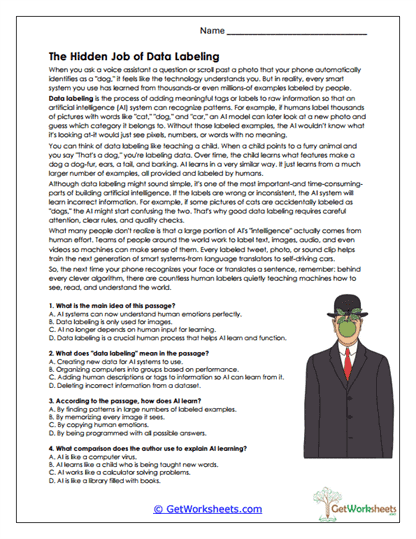
Hidden Job of Labeling
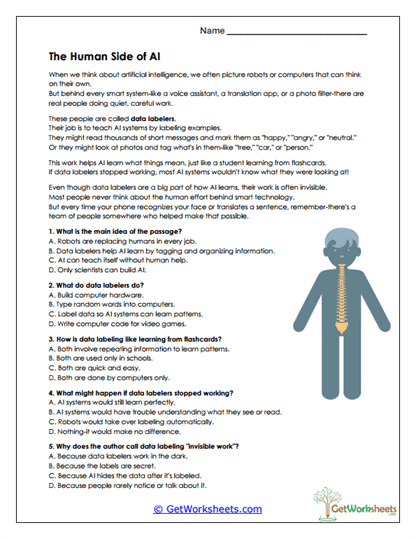
Students read an informational passage about how AI systems learn from thousands of labeled examples and then answer multiple-choice questions. The activity reinforces understanding of pattern learning, human annotation, and how mislabeled data affects performance. It helps students grasp the unseen human labor behind AI tools. The worksheet strengthens vocabulary and main idea comprehension.
When Labels Go Wrong
In this worksheet, students explore how incorrect labels cause AI systems to misinterpret information or make unsafe predictions. They answer multiple-choice questions focused on consequences, examples, and main ideas. The activity builds awareness of the importance of accuracy and consistency in datasets. It strengthens informational text analysis and cause-and-effect reasoning.
Human Side of AI
Students learn how human data labelers help AI understand emotions, categorize objects, and interpret patterns. They answer questions that highlight the limitations of AI without human oversight. This worksheet reinforces the value of nuance and judgment in labeling. It deepens comprehension of how human reasoning shapes AI learning.
Smart Labeling Scenarios
Learners evaluate labeling strategies for three different AI tasks involving emotions, food types, and road signs. After choosing the best label set, they explain their reasoning in complete sentences. The activity promotes thoughtful analysis of category choices and consistency. Students practice applying labeling decisions to realistic situations.
Solving AI's Confusing Crimes
Students examine three cases where AI failed due to mislabeled data and respond to guiding questions about what went wrong. They analyze consequences and propose solutions, encouraging investigative thinking. The worksheet strengthens cause-and-effect reasoning and error diagnosis. It highlights how careful labeling prevents dangerous AI outcomes.
Human vs. AI Judgment
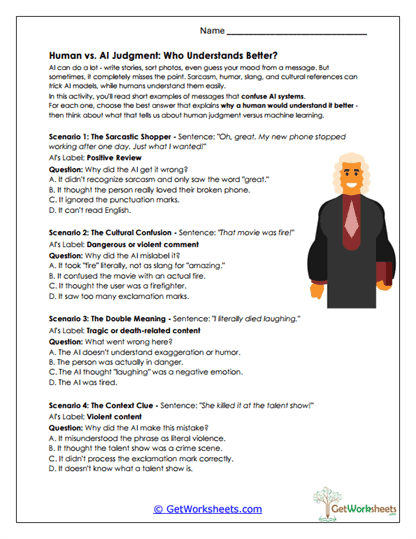
This worksheet presents scenarios where AI misinterprets sarcasm, cultural references, or figurative language. Students compare human and AI interpretations and answer questions about why the AI misunderstood. The activity develops inferencing and tone analysis. It reinforces understanding of social context and human insight.
Labeling Expert Practice
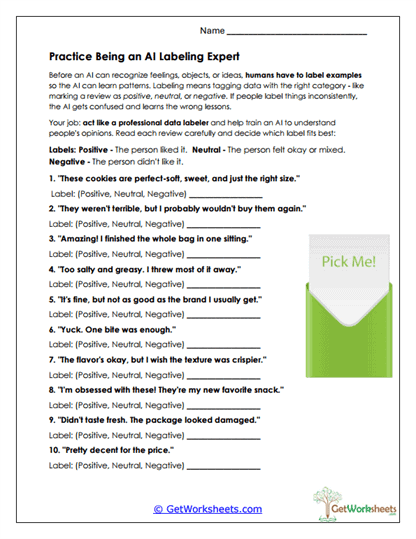
Students label opinion statements as Positive, Neutral, Negative, or Mixed, mimicking sentiment analysis tasks. They evaluate tone, emotion, and intention while making labeling decisions. The worksheet strengthens judgment skills and careful reading. It offers firsthand experience in how sentiment labeling trains AI systems.
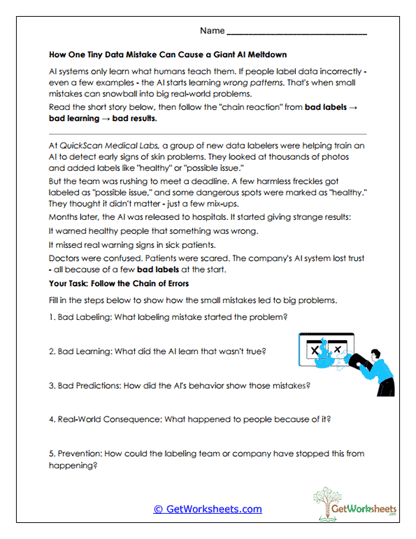
Chain Reaction of Errors
Learners trace how mislabeling in medical images led to widespread AI mistakes and unsafe predictions. They complete prompts that guide them through each step of the error cascade. The activity builds understanding of sequential processes and the impact of small mistakes. It deepens appreciation of accuracy in machine learning workflows.
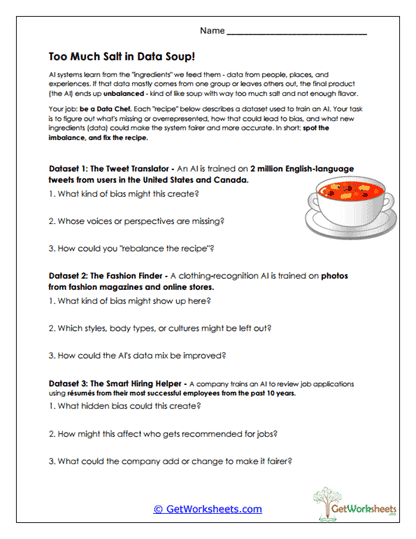
Data Soup Bias Hunt
Students analyze datasets to identify potential bias caused by missing voices or imbalanced representation. They answer questions about fairness and how datasets can be improved. This worksheet encourages ethical thinking and awareness of diversity in data design. It strengthens analytical reasoning and understanding of bias in AI.
Should We Label That?
Learners explore complex labeling dilemmas involving gender, offensive comments, and accents. They answer open-ended questions requiring empathy, ethical reasoning, and consideration of potential harm. The activity promotes responsible data practices and awareness of sensitive contexts. Students develop thoughtful decision-making skills.
Label Taxonomy Builder
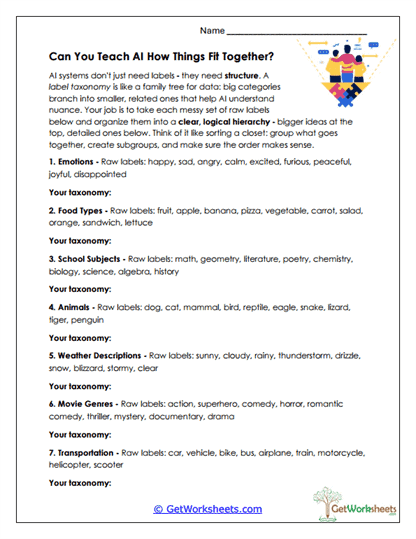
Students reorganize sets of raw labels into structured hierarchies, learning how taxonomies help AI understand categories more clearly. They identify major groups, subgroups, and logical relationships. This worksheet strengthens classification and organizational thinking. It highlights how structured data supports accurate AI learning.
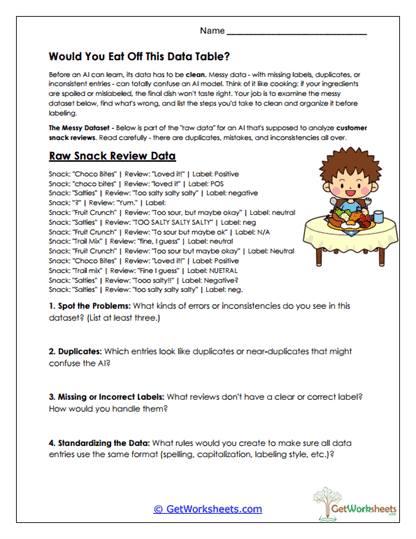
Data Table Cleanup
Learners analyze a messy dataset with duplicates, inconsistencies, and unclear labels. They identify errors, propose cleanup rules, and reflect on how poor data quality harms AI performance. The activity builds data literacy and attention to detail. It models essential preprocessing steps used in real AI development.
Bookmark Us Now!
New, high-quality worksheets are added every week! Do not miss out!