Cloud Types and Formation Worksheets
About This Worksheet Collection
This cloud-themed worksheet collection offers teachers a diverse set of resources that make meteorology clear, approachable, and engaging for students. From hands-on sketching activities to observation journals and scenario-based predictions, the materials invite learners to interact with atmospheric science in meaningful ways. Whether used in a classroom unit on weather or as part of a science center rotation, this assortment provides flexibility and depth, ensuring students build understanding through multiple modes of learning.
Throughout the collection, students strengthen key scientific skills such as classification, pattern recognition, data analysis, and explanatory writing. They learn how cloud appearance connects to weather patterns, develop vocabulary critical to earth science, and practice interpreting visual and textual information. By working through these pages, learners gain the foundational knowledge needed to make sense of the sky above them while building confidence as scientific thinkers.
Detailed Descriptions Of These Worksheets
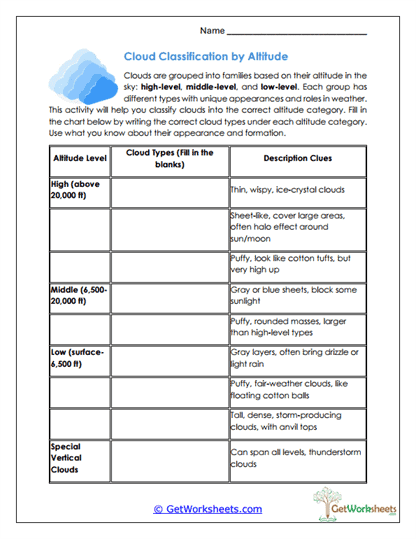
Cloud Classification
This worksheet guides students in sorting cloud types into altitude-based categories by examining shape, texture, and height clues. As they work through the chart, learners refine their ability to interpret descriptive scientific language. The exercise also reinforces how cloud appearance changes with atmospheric layers. By organizing information visually, students deepen their understanding of cloud diversity and structure.
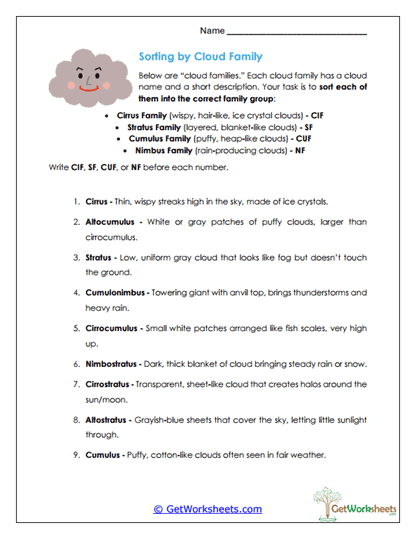
Cloud Family Sorting
Students review short cloud descriptions and determine which family-cirrus, stratus, cumulus, or nimbus-each example belongs to. The worksheet encourages learners to look for subtle differences that signal weather patterns and cloud behavior. Through the sorting task, they strengthen their use of scientific vocabulary and improve their confidence in classification work.
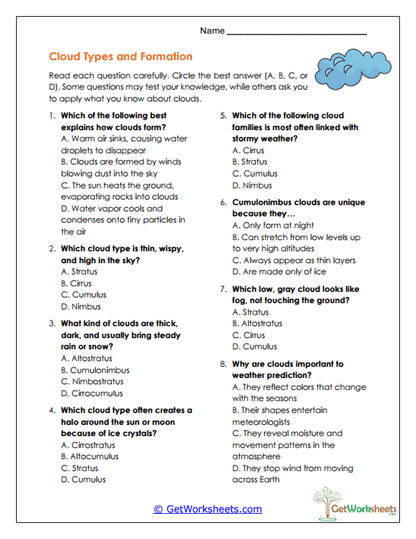
Cloud Formation Review
This multiple-choice activity asks students to apply their knowledge of cloud development and recognize how factors like altitude, temperature, and moisture influence formation. Each question prompts learners to make connections between appearance and weather outcomes. The format provides helpful practice in scientific reasoning while reinforcing essential meteorology concepts.
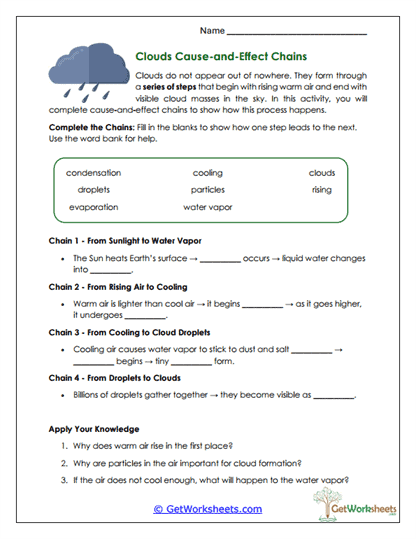
Cloud Cause-and-Effect Chains
Learners complete a series of connected steps that map the process of cloud formation, using terminology supplied in a word bank. This visual sequence helps students understand the progression from evaporation to condensation and finally to visible cloud masses. By identifying each stage, they develop a clearer sense of how atmospheric processes build on one another. Four reflective prompts invite students to connect these ideas to real examples in nature.
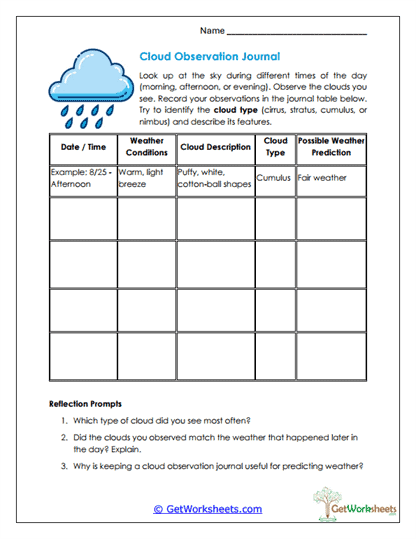
Cloud Observation Journal
Students head outdoors (or look through a window) to record real cloud sightings at different times of day. They note weather conditions, describe what they observe, classify the clouds, and make predictions about upcoming weather. This journaling approach deepens students' observational skills and encourages them to link visual evidence to meteorological understanding.
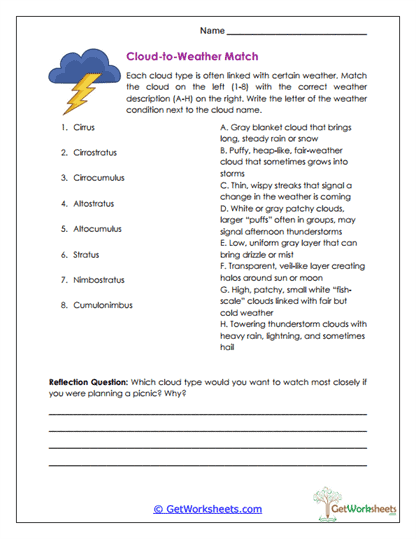
Cloud-to-Weather Match
In this matching activity, students connect cloud names to weather descriptions by using clues such as color, height, and texture. The task strengthens students' ability to recognize which clouds signal calm skies and which hint at storms or precipitation. A reflection question pushes them to think about how noticing clouds can help with everyday weather awareness.
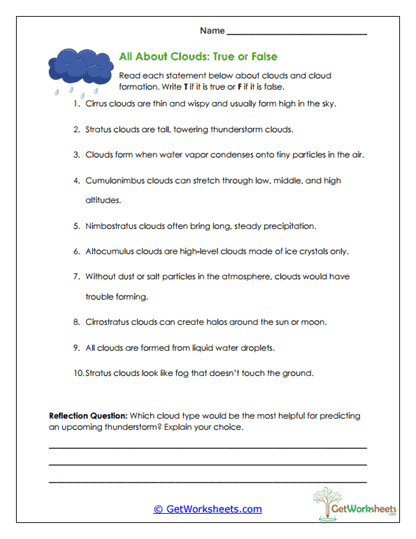
Cloud True or False
Students analyze statements about cloud traits, formation steps, and weather associations to determine whether each claim is accurate. This encourages learners to confront common misconceptions and refine their understanding of atmospheric science. The worksheet builds scientific literacy by emphasizing careful reading and factual verification.
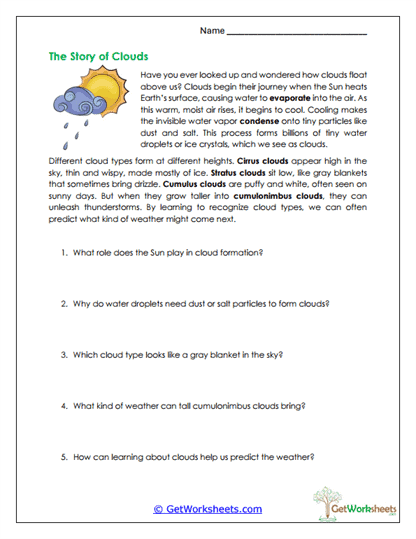
Story of Clouds
After reading an explanatory passage about evaporation, cooling, condensation, and droplet formation, students answer open-ended questions that test comprehension. The activity blends narrative clarity with scientific content, helping learners see cloud formation as a sequence rather than isolated facts. Their written responses encourage evidence-based thinking and thoughtful application.
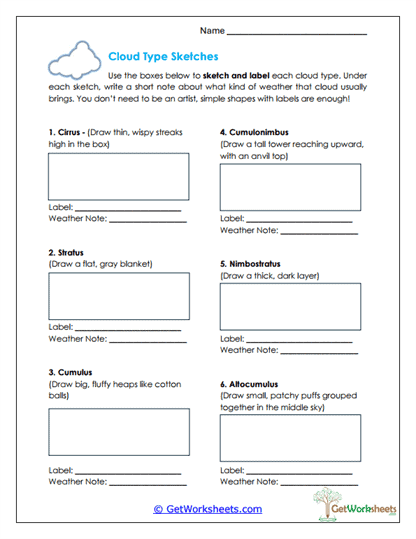
Cloud Type Sketches
Students draw simple representations of major cloud types and annotate each with notes about typical weather conditions. The sketching process helps solidify distinctions in shape and structure, while the written component reinforces atmospheric knowledge. This combination of visual and textual learning strengthens retention and interpretation skills.
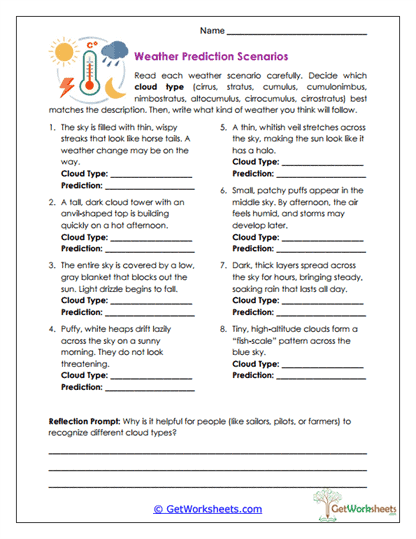
Weather Prediction Scenarios
Learners read short weather descriptions that hint at specific cloud types and must identify both the cloud and the likely weather outcome. The scenarios provide realistic contexts that make meteorology feel relevant and practical. By interpreting observational clues, students practice applying their knowledge to real-world situations.
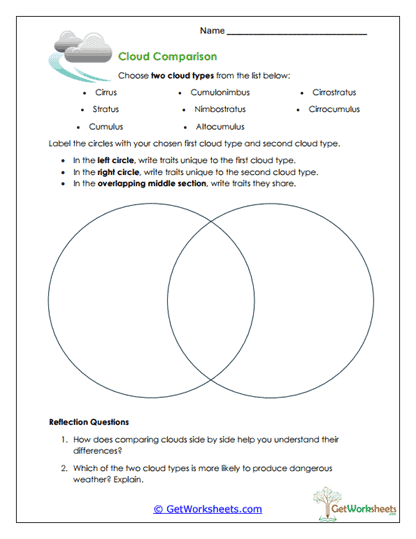
Cloud Comparison
Using a Venn diagram, students compare and contrast two cloud types of their choice, noting unique traits and shared features. This visual organizer helps learners think critically about how clouds relate to one another in terms of altitude, shape, and weather effects. The reflection questions encourage students to consider why these differences matter for predicting weather.
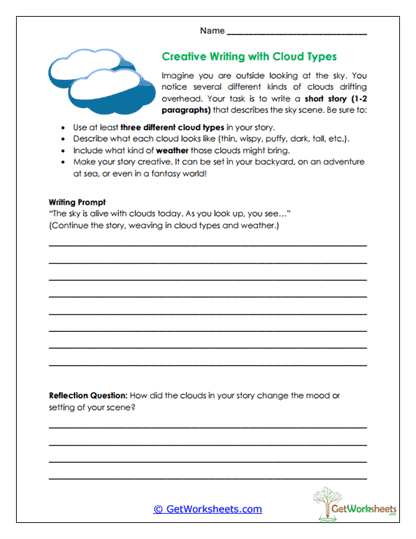
Cloud Creative Writing
Students craft a short story that incorporates at least three cloud types, describing each accurately while integrating their associated weather patterns into the narrative. The task blends scientific understanding with imaginative writing, making meteorology feel vivid and expressive. By connecting cloud behavior to mood and setting, learners strengthen both descriptive language and content knowledge.
Bookmark Us Now!
New, high-quality worksheets are added every week! Do not miss out!