Brown v. Board of Education Worksheets
-
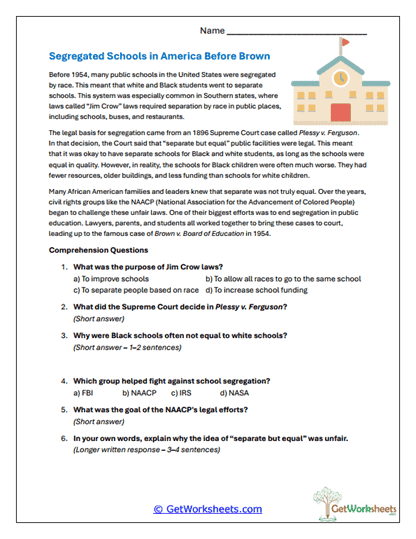
A Segregation Before Brown
-
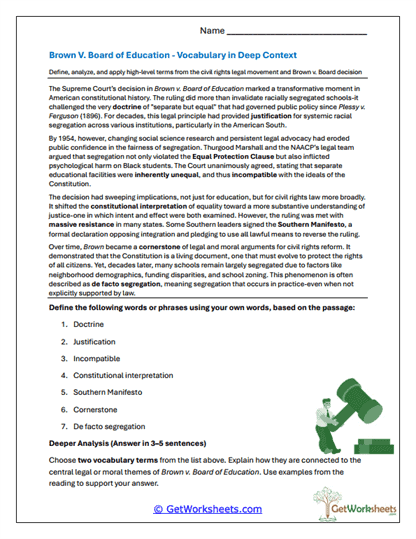
Advanced Vocabulary Analysis
-
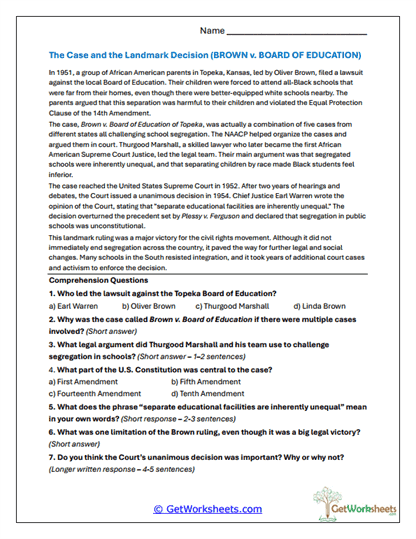
Brown v. Board Case Study
-
-
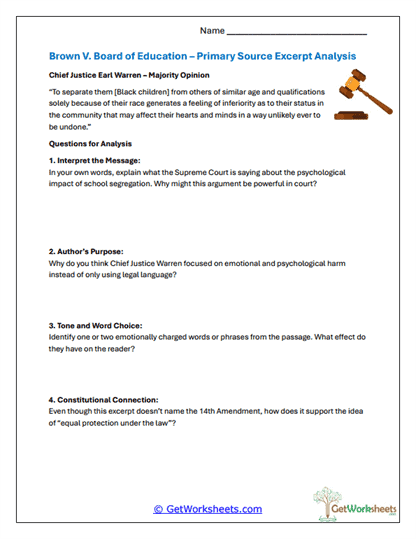
Chief Justice Opinion Analysis
-
Civil Rights Timeline Puzzle
-
Civil Rights Vocabulary Builder
-
Critical Thinking and Reflection
-
Interpreting Brown v. Board Quotes
-
Legacy of Brown v. Board
-
Primary Source Analysis – Brown Decision
-
The Struggle for Integration
-
Vocabulary in Legal Context
About This Worksheet Collection
The Brown v. Board of Education worksheet collection guides students through one of the most transformative moments in American legal and civil rights history. Each worksheet is designed to help learners understand the background of segregation, the landmark 1954 Supreme Court decision, and its far-reaching social impact. With readings, vocabulary activities, primary source analysis, and reflective writing tasks, this collection provides educators with flexible tools for teaching about equality, justice, and the power of civic change.
Students using these worksheets will strengthen critical academic skills while deepening their understanding of constitutional law and social reform. They'll learn to interpret complex texts, analyze primary sources, evaluate arguments, and connect historical decisions to modern issues of equity. Together, these resources promote literacy, empathy, and informed citizenship by helping learners see how legal rulings shape real lives and communities.
Detailed Descriptions Of These Worksheets
Segregation Before Brown
Students explore what life was like under segregation prior to the Brown v. Board ruling, focusing on Jim Crow laws and the effects of Plessy v. Ferguson. The reading passage highlights unequal school conditions and the realities faced by Black students. Learners answer comprehension and short-response questions that develop historical awareness and reading accuracy. This lesson provides essential background for understanding why desegregation was so urgent.
Brown v. Board Case Study
This worksheet walks students through the legal battle that reshaped education in America. They learn about Oliver Brown's role as plaintiff, Thurgood Marshall's groundbreaking arguments, and the Supreme Court's unanimous decision. The questions encourage analysis of the 14th Amendment and the Court's reasoning. It's a clear, focused introduction to how constitutional interpretation can advance justice.
Civil Rights Timeline Puzzle
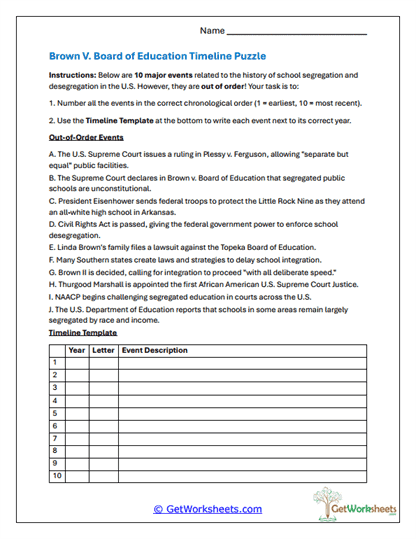
Students piece together major moments from Plessy v. Ferguson to Brown v. Board and beyond in this sequencing challenge. By arranging ten events in chronological order and summarizing each one, learners visualize the slow march toward desegregation. The exercise builds organization, summarization, and pattern recognition. It's an interactive way to connect legal progress with historical continuity.
Civil Rights Vocabulary Builder
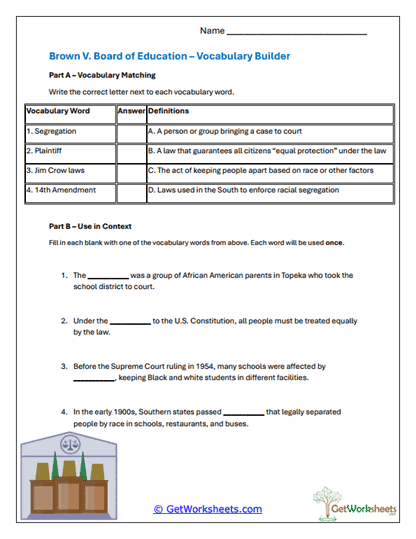
Learners strengthen key vocabulary related to civil rights law and history. They match and use words like "segregation," "plaintiff," and "14th Amendment" to demonstrate comprehension. This exercise helps students read and discuss historical texts with confidence. It also reinforces understanding of how language shapes civic learning.
Vocabulary in Legal Context
Students analyze important legal terms in a short reading about Brown v. Board of Education. They define and apply words such as "precedent" and "unconstitutional," using textual context to infer meaning. This worksheet builds precise vocabulary and strengthens comprehension of judicial reasoning. It's ideal for bridging history and civics instruction.
Advanced Vocabulary Analysis
This higher-level worksheet challenges students to unpack complex terms like "Southern Manifesto" and "de facto segregation." After defining each term, learners explain how two of them connect to the larger civil rights struggle. The activity deepens critical thinking and contextual understanding. It's especially effective for advanced middle or high school readers analyzing the language of equality.
Primary Source Analysis - Brown Decision
Students engage directly with an excerpt from Chief Justice Earl Warren's 1954 opinion. Guided questions lead them to interpret tone, meaning, and the principle that "separate educational facilities are inherently unequal." This activity cultivates close reading and civic literacy. It's an accessible introduction to primary source interpretation in constitutional history.
Chief Justice Opinion Analysis
Focusing on the persuasive language of Warren's opinion, this worksheet invites students to explore how emotion and logic intertwine in judicial writing. They connect the reasoning to the 14th Amendment's Equal Protection Clause while evaluating tone and intent. The activity enhances comprehension and analysis of legal argumentation. It's an engaging blend of literature and law.
Critical Thinking and Reflection
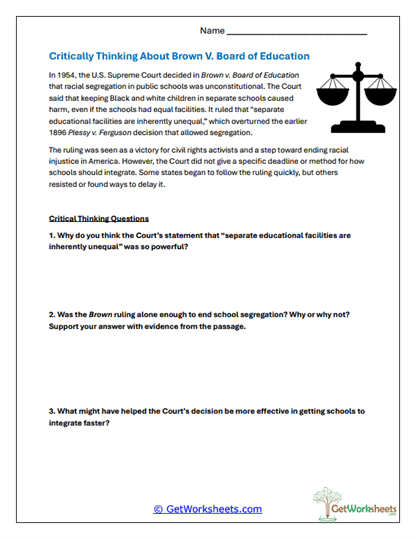
This worksheet promotes thoughtful reflection on the meaning and consequences of Brown v. Board. Students consider why the ruling was so groundbreaking, what obstacles limited progress, and how true integration could have been achieved faster. The activity encourages evidence-based reasoning and personal insight. It's perfect for fostering discussion and deeper understanding of social change.
Interpreting Brown v. Board Quotes
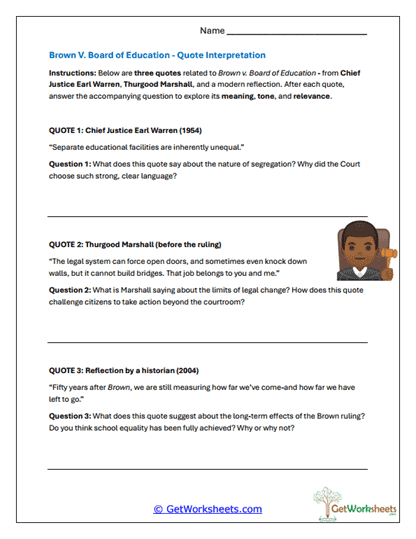
Learners interpret quotations from figures like Chief Justice Earl Warren and Thurgood Marshall alongside commentary from a modern historian. Each quote invites analysis of tone, message, and relevance today. This exercise strengthens critical reading and connects past struggles to ongoing conversations about equity. It helps students see the living legacy of the decision.
The Struggle for Integration
Through an informational passage, students trace the challenges of enforcing desegregation after Brown v. Board. They learn about the Little Rock Nine, state resistance, and federal intervention under President Eisenhower. Comprehension questions highlight the gap between law and lived experience. This worksheet builds empathy, historical insight, and an understanding of civic enforcement.
Legacy of Brown v. Board
This reading activity examines how Brown v. Board reshaped education and society over time. Students learn about later victories like the Civil Rights Act and continuing inequalities linked to housing and economics. Reflection questions encourage discussion of modern segregation and systemic inequity. The lesson promotes critical thought and civic awareness of justice as an ongoing pursuit.
Bookmark Us Now!
New, high-quality worksheets are added every week! Do not miss out!