Black Holes Worksheets
About This Worksheet Collection
The Black Holes collection immerses students in the mysteries of one of the universe's most fascinating phenomena. Through informational readings, analytical exercises, and creative projects, learners explore how black holes form, behave, and influence surrounding space. The worksheets blend astronomy, physics, and literacy skills, teaching students to interpret scientific text, understand cause-and-effect relationships, and apply complex terminology accurately.
This collection encourages inquiry-based learning by pairing rigorous comprehension with imagination. From sequencing the life cycle of stars to writing science-inspired stories, students develop both analytical reasoning and expressive communication. Each activity fosters curiosity, strengthens content-area vocabulary, and connects scientific exploration to real-world discovery and creative thinking.
Detailed Descriptions Of These Worksheets
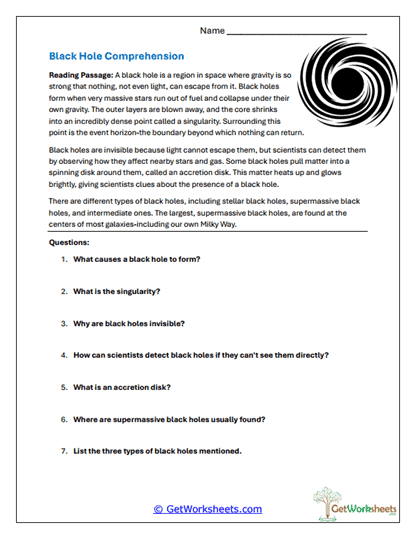
Black Hole Comprehension
Students read an accessible nonfiction passage defining black holes, explaining their formation, and describing how scientists detect them indirectly. The text introduces key terms like singularity, event horizon, and accretion disk. Learners answer comprehension questions focused on causes, characteristics, and types of black holes. The worksheet builds foundational knowledge and strengthens astronomy vocabulary.
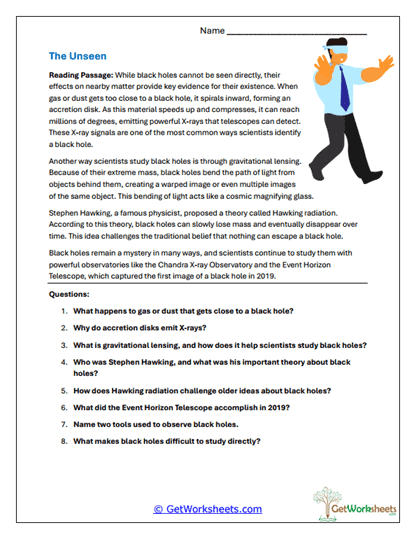
The Unseen
Learners study how scientists observe black holes through indirect evidence, such as X-rays, radiation, and gravitational lensing. The passage highlights major contributions from Stephen Hawking and the first photograph of a black hole. Students analyze cause and effect between technology and discovery. This activity promotes understanding of evidence-based astronomy and scientific progress.
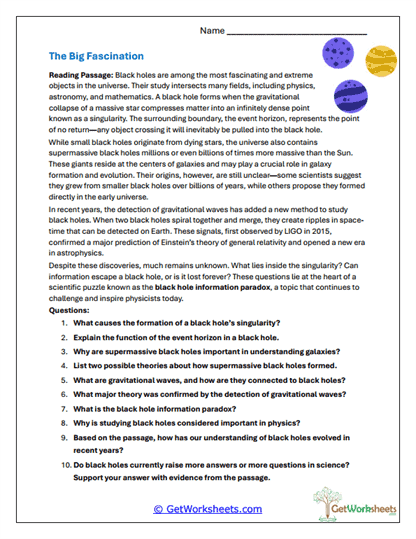
The Big Fascination
Students examine advanced concepts including supermassive black holes, event horizons, and gravitational waves. They answer higher-order questions requiring synthesis of information across paragraphs. The passage challenges learners to think critically about evolving astrophysical theories. It encourages deep comprehension of how modern science investigates cosmic mysteries.
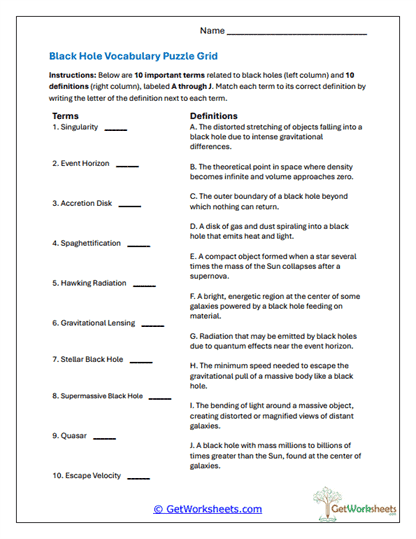
Black Hole Vocabulary Puzzle Grid
Learners connect key astronomy terms to their definitions through a vocabulary-matching grid. Terms include gravitational lensing, event horizon, and accretion disk. This puzzle format supports engagement and retention of specialized vocabulary. It enhances comprehension by linking technical language to scientific meaning.
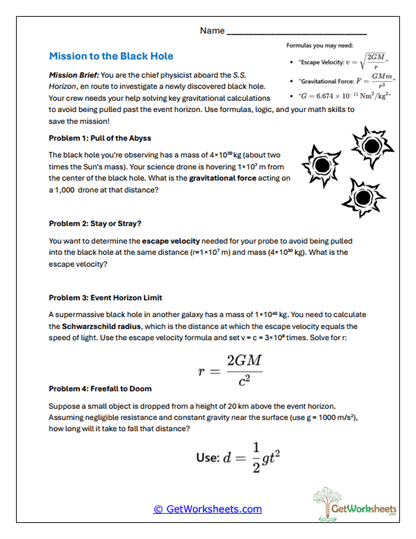
Mission to the Black Hole
Students take on the role of astrophysicists solving applied problems about gravity, escape velocity, and the Schwarzschild radius. Using formulas and data, they calculate forces acting near a black hole. The scenario integrates math and science in a hands-on STEM challenge. It strengthens quantitative reasoning and conceptual understanding of physics.
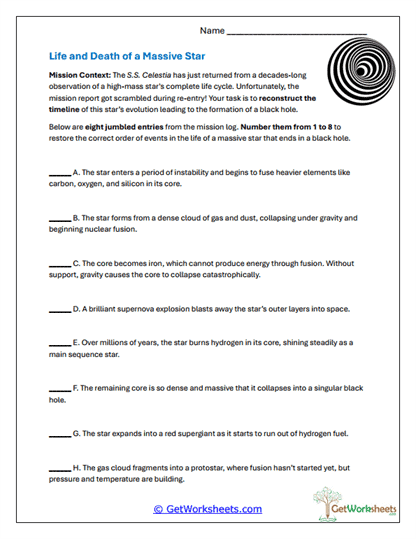
Life and Death of a Massive Star
Learners sequence the life cycle of a massive star-from its birth in a nebula to its collapse into a black hole. They organize jumbled events into logical order, reinforcing understanding of stellar evolution. The activity builds cause-and-effect comprehension and scientific organization skills. It visualizes the transformation of matter and energy in space.
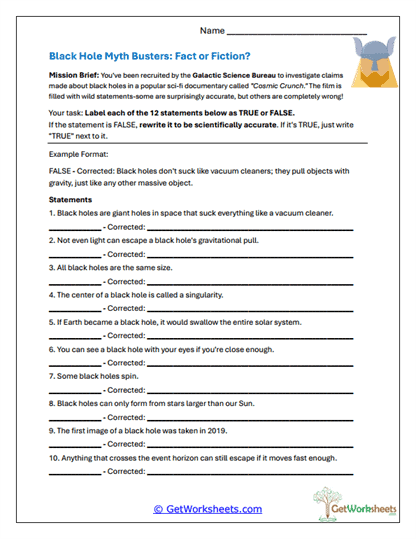
Black Hole Myth Busters: Fact or Fiction?
Students evaluate statements about black holes, marking them true or false and correcting inaccuracies. The exercise dispels common myths about size, gravity, and visibility. Learners apply evidence-based reasoning to confirm scientific facts. This worksheet promotes accuracy, skepticism, and scientific literacy.
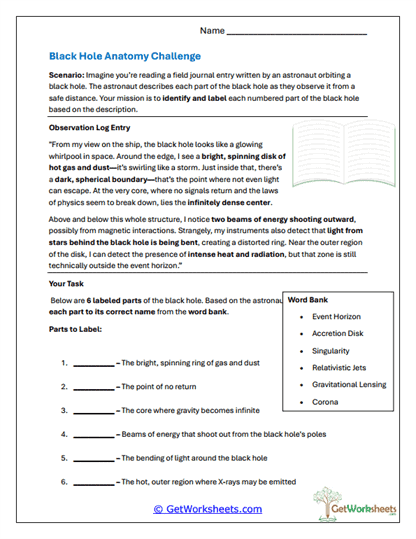
Black Hole Anatomy Challenge
Learners label the main parts of a black hole-such as the event horizon, accretion disk, and relativistic jets-based on an astronaut's descriptive log. They interpret text clues to match numbered diagram features. The task integrates reading comprehension with visual-spatial reasoning. It deepens conceptual understanding through applied labeling.
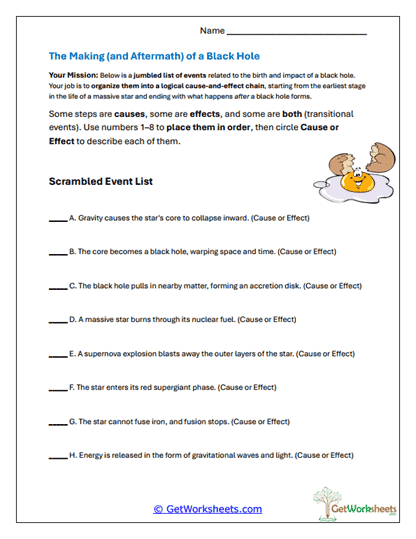
Black Hole Formation
Students organize cosmic events like supernova explosions and gravitational collapse into a cause-and-effect sequence showing how black holes form. They classify each event as either a cause or effect, reinforcing logical reasoning. The task connects astrophysical processes to scientific explanation. It cultivates sequencing and comprehension of stellar transformation.
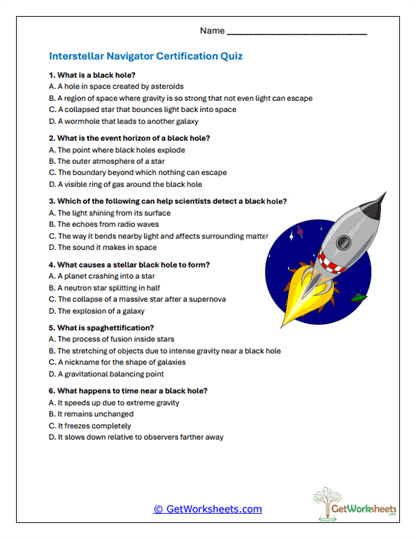
Interstellar Quiz
This multiple-choice quiz evaluates students' understanding of black hole properties, gravity, and matter behavior. Learners analyze realistic scenarios and select accurate explanations. The questions strengthen test-taking skills and content mastery. The format provides an engaging review of astrophysical knowledge and vocabulary.
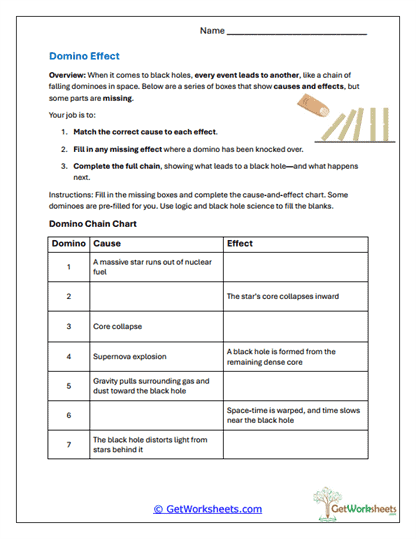
Black Hole Dominoes
Students match causes and effects of stellar evolution in a visual "domino effect" chart. They connect nuclear fusion, supernovae, and gravitational collapse in the proper order. The worksheet promotes logical sequencing and pattern recognition. It reinforces comprehension of how interconnected processes lead to black hole formation.
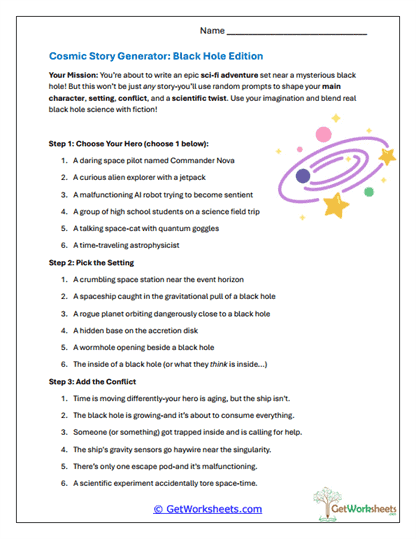
Cosmic Story Builder
Learners craft imaginative yet scientifically grounded stories about space exploration and black holes. Guided prompts help them develop character, setting, and conflict using real physics concepts like time dilation and gravitational pull. This activity merges creative writing with science learning. It encourages expression, curiosity, and interdisciplinary thinking.
Bookmark Us Now!
New, high-quality worksheets are added every week! Do not miss out!