Analogy Worksheets
About This Worksheet Collection
The Analogy worksheet collection helps students develop logical thinking, vocabulary depth, and comprehension of word relationships. Each worksheet challenges learners to recognize how words connect by meaning, function, or association-skills essential for both literacy and problem-solving. By exploring analogies drawn from language, science, and real-life examples, students sharpen reasoning and pattern-recognition abilities that strengthen both their verbal and analytical fluency.
Through varied activities, learners will decode, complete, and even create analogies while expanding their understanding of synonyms, antonyms, and categories. They'll apply context clues, interpret figurative language, and make cross-curricular connections across subjects such as science and social studies. Together, these exercises turn vocabulary into a thinking tool-encouraging flexibility, precision, and insight into how words and ideas relate.
Detailed Descriptions Of These Worksheets
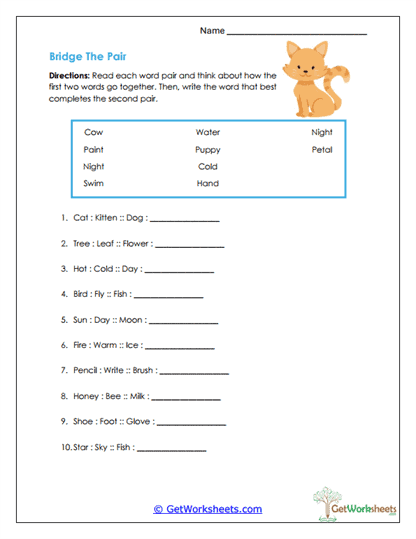
Bridge the Pair
Students complete analogy pairs by determining how two words are related-by function, category, or meaning-and applying that relationship to a new set. The task develops critical thinking and word association skills. It encourages students to think beyond surface meanings, strengthening both logic and vocabulary comprehension.
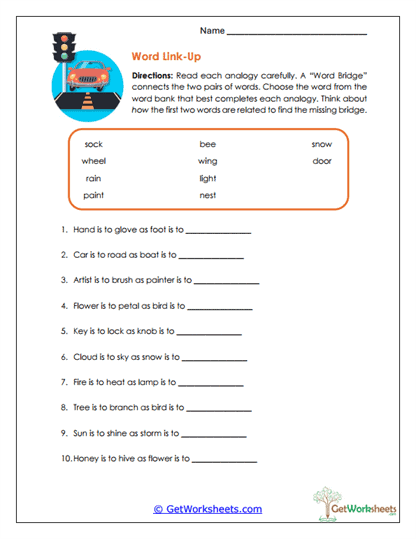
Word Link-Up
Learners choose the correct "word bridge" from a list to complete each analogy. This practice reinforces recognition of part-to-whole, cause-and-effect, and comparison relationships. It improves deductive reasoning and contextual understanding. Students gain confidence in identifying precise linguistic connections.
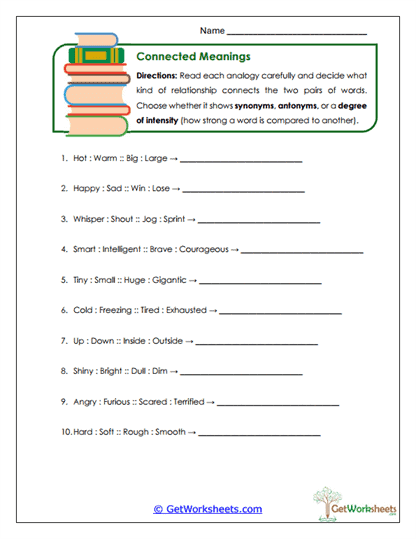
Connected Meanings
This worksheet focuses on comparing word pairs through synonym, antonym, and degree relationships. Learners explore how similar words can differ in strength or tone. The exercise deepens vocabulary awareness and enhances descriptive precision in writing and reading comprehension.
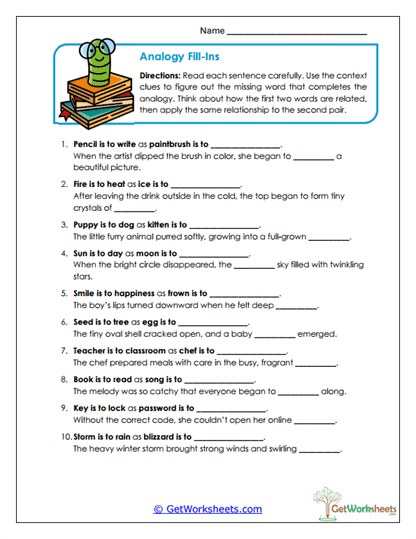
Analogy Fill-Ins
Students infer missing words in analogy sentences using contextual clues. Each example places analogical thinking within real-world settings, linking logic with comprehension. It's a practical activity for improving inference and vocabulary in one integrated task.
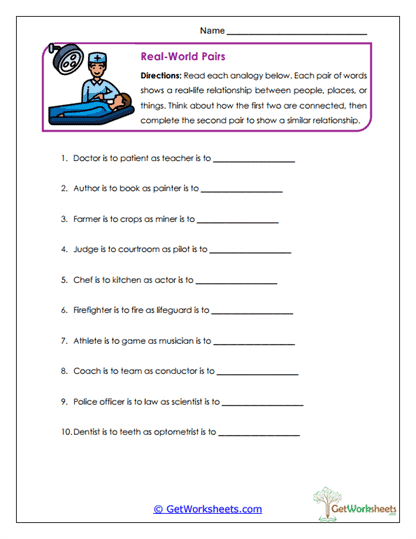
Real-World Pairs
Learners complete analogies based on familiar professions, places, and relationships-like "doctor : patient :: teacher : student." This exercise connects reasoning with daily life, strengthening understanding of roles and functions. It's an engaging bridge between language and real-world awareness.
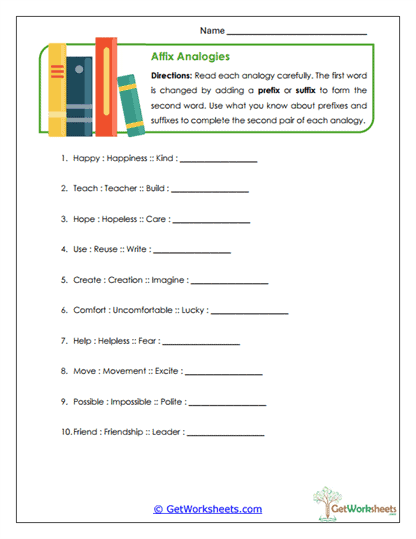
Affix Analogies
Students analyze analogies formed through prefixes and suffixes, such as happy : happiness :: kind : kindness. The worksheet reinforces morphological understanding and vocabulary growth. It highlights how word parts convey meaning and structure in language.
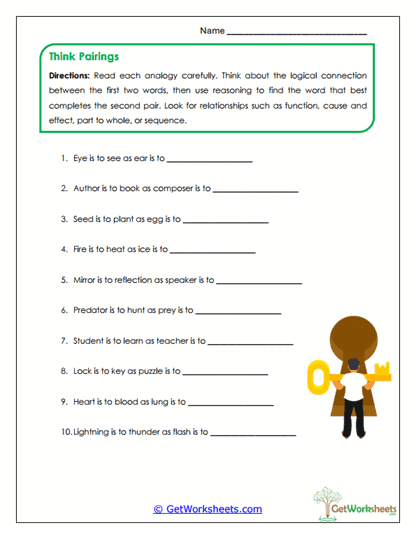
Think Pairings
Learners encounter multiple analogy types-including function, cause and effect, and part-to-whole-and identify the logical word that completes each. This task sharpens pattern recognition, analytical reasoning, and vocabulary precision. It's a comprehensive introduction to analogy logic.
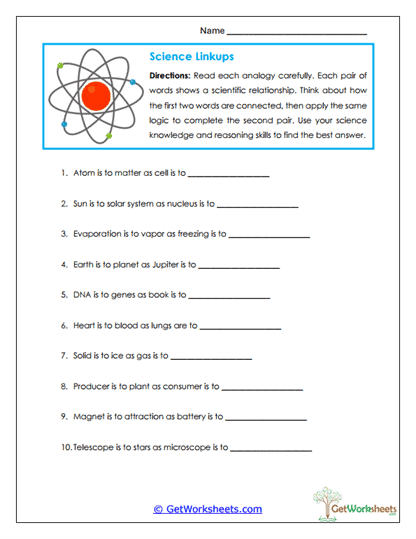
Science Linkups
Students apply analogical reasoning to scientific terms, such as DNA : genes :: book : words. The exercise merges STEM and language learning, emphasizing conceptual understanding across disciplines. It promotes cross-curricular thinking and reinforces science vocabulary.
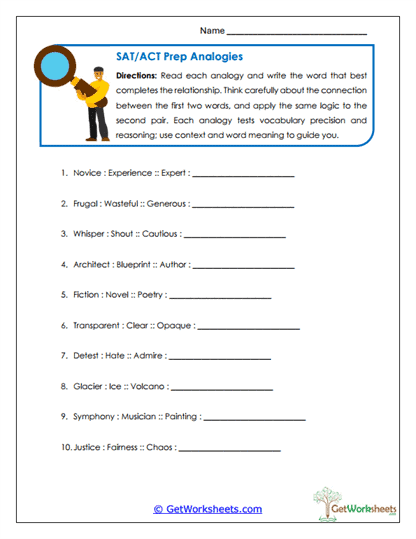
College Prep Analogies
This advanced worksheet mirrors standardized test-style analogies. Learners analyze relationships such as synonyms, antonyms, or intensity gradients to complete word pairs accurately. It builds higher-level vocabulary, reading precision, and logical structure awareness essential for academic readiness.
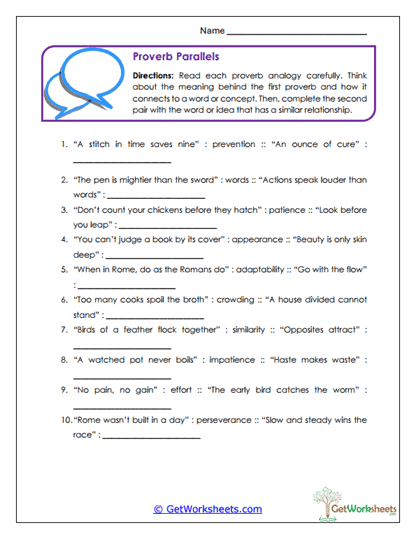
Proverb Analogies
Students interpret the underlying lessons of familiar proverbs and pair them with sayings of similar meaning. This higher-order task promotes abstract reasoning and cultural literacy. It develops figurative thinking and understanding of universal themes like patience and cooperation.
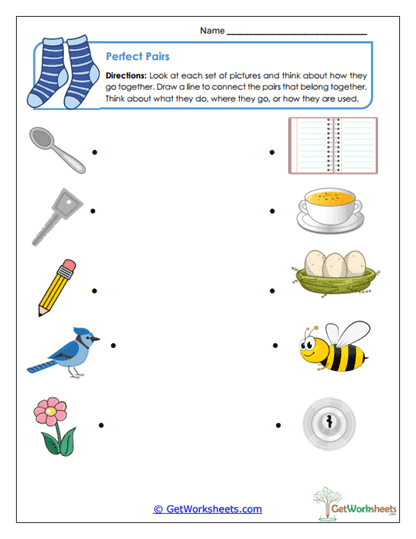
Picture Pairing
Designed for early learners or English language learners, this visual worksheet invites students to connect related images-such as a key to a lock or a bee to a flower. The hands-on matching promotes observation, categorization, and oral language development.
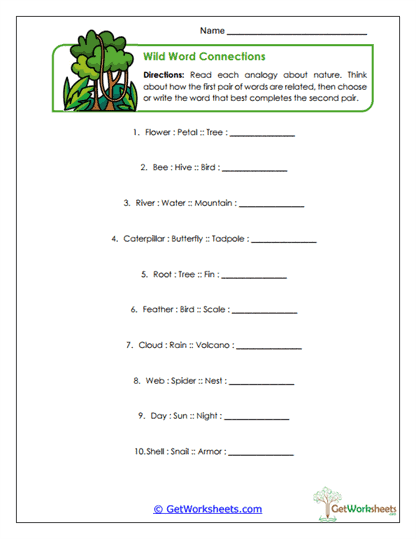
Nature Word Analogies
Learners complete nature-themed analogies focusing on plants, animals, and habitats. Relationships like flower : petal :: tree : leaf reinforce part-whole reasoning and scientific vocabulary. The worksheet integrates language arts and science, supporting both content mastery and critical thinking.
Bookmark Us Now!
New, high-quality worksheets are added every week! Do not miss out!