AI vs. Human Thinking Worksheets
About This Worksheet Collection
The AI vs. Human Thinking collection invites students to compare how humans and artificial intelligence approach reasoning, creativity, problem-solving, and interpretation. Each worksheet highlights moments where AI excels, where humans shine, and where both use very different strategies to reach answers. Through scenarios, riddles, editing tasks, classification challenges, and logic puzzles, students gain a deeper understanding of cognitive differences while sharpening their analytical and writing skills.
Across the collection, learners practice evaluating claims, identifying errors, explaining reasoning, interpreting figurative language, and reflecting on instinct versus logic. They examine how AI handles patterns, facts, and calculations, while humans bring intuition, emotion, creativity, and common sense. These activities strengthen critical thinking, deepen technology literacy, and give students meaningful insight into how intelligent systems and people solve problems differently.
Detailed Descriptions Of These Worksheets
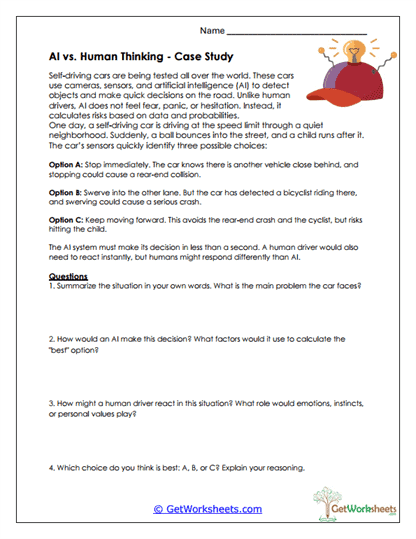
AI vs. Human Case Study
Students analyze an ethical scenario involving a self-driving car and evaluate three possible decisions the AI might make. They summarize the dilemma, compare AI logic to human instincts, and defend their chosen solution. This activity encourages thoughtful reasoning and the clear explanation of complex ideas. It also supports understanding of how emotions and ethical considerations differ from computational decision-making.
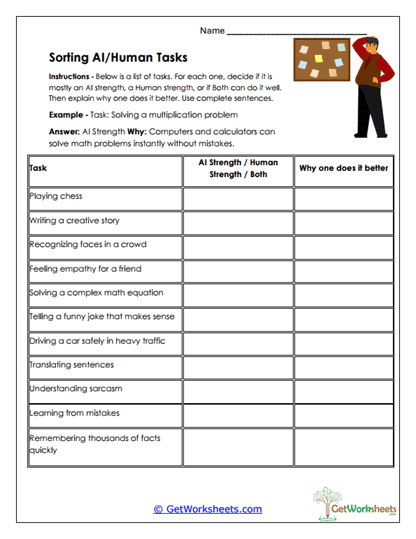
AI/Human Task Sorting
In this worksheet, students classify everyday tasks as AI strengths, human strengths, or shared abilities. They support each classification with complete-sentence explanations. The task builds comparison skills and deepens understanding of what machines can and cannot do well. It also reinforces clear reasoning about cognitive differences.
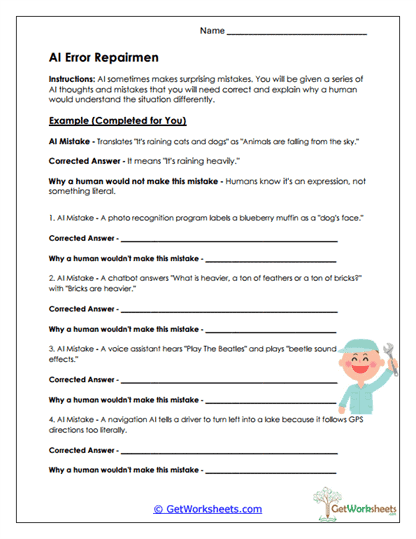
AI Error Repair
Learners correct AI misunderstandings such as literal interpretations and idiom errors, then explain why humans are unlikely to make the same mistake. The activity strengthens use of context clues and figurative language. It helps students contrast machine logic with human common sense. They also practice precise correction and explanation.
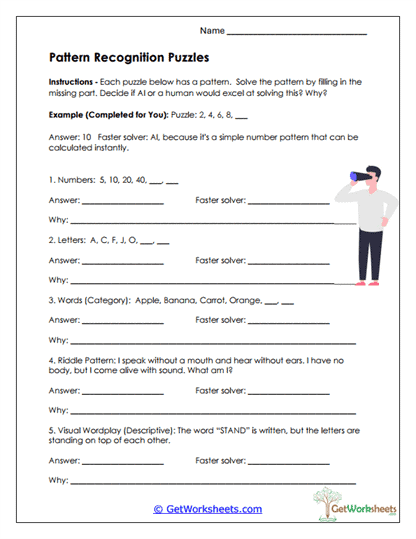
Pattern Recognition Puzzles
Students solve puzzles involving sequences, categories, riddles, and wordplay, then decide whether a human or an AI would solve each one faster. The worksheet highlights different problem-solving strengths across humans and machines. It builds logical reasoning and interpretation skills. Students gain insight into the contrast between computational pattern-finding and human abstract thinking.
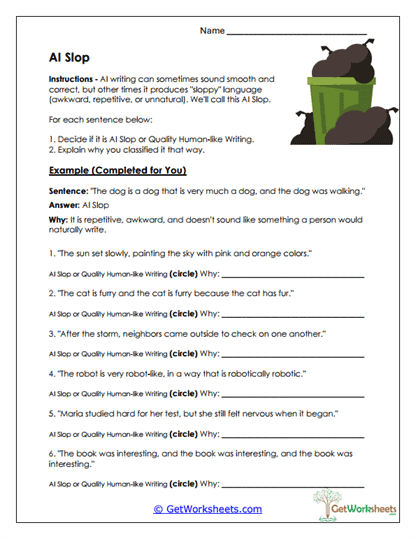
AI Slop Detector
This worksheet teaches students to identify awkward, repetitive, or unnatural AI-generated sentences. They classify each example as AI-like or human-like and justify their reasoning. The activity develops awareness of tone, clarity, and natural language flow. Students strengthen their ability to recognize stylistic and structural writing issues.
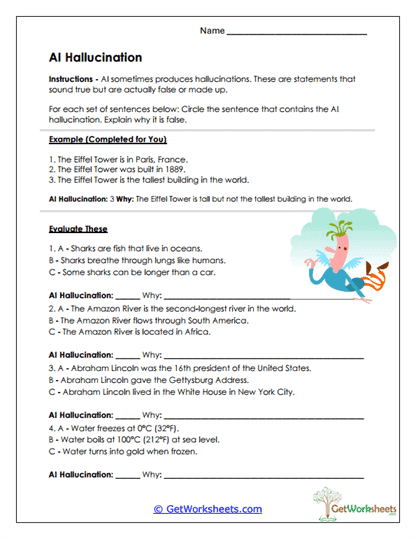
AI Hallucination Finder
Students examine sets of factual statements and identify the one that is incorrect, simulating an AI "hallucination." They explain why the chosen statement is false and reflect on how humans and AI detect errors differently. This builds fact-checking skills and strengthens content knowledge. It also encourages careful evaluation of claims.
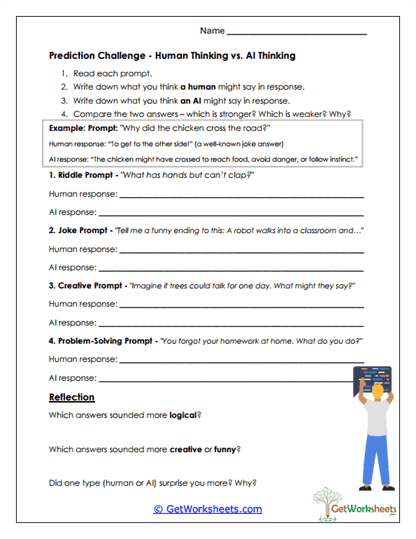
Human vs. AI Response Challenge
Learners create both human-style and AI-style responses to riddles, jokes, creative prompts, and problem-solving tasks. They compare the strengths of each response type, discussing creativity, logic, and humor. This activity helps students understand expressive differences between human thinking and machine reasoning. It develops versatile writing and reflective analysis.
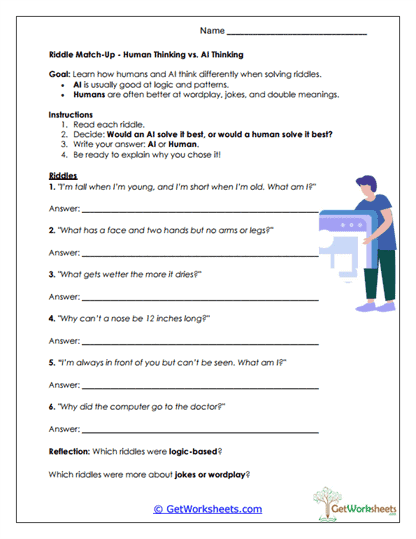
Riddle Match-Up
Students solve riddles and determine whether a human or an AI would solve each one more effectively. They justify their choices by discussing wordplay, double meanings, and logic. The worksheet reinforces vocabulary, inference, and figurative language skills. It also builds awareness of how different thinkers approach puzzles.
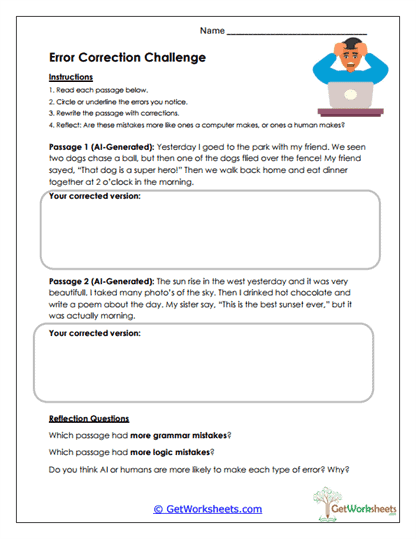
Error Correction Challenge
This worksheet presents flawed AI-generated passages that contain grammatical or logical errors. Students mark the mistakes, rewrite corrected versions, and reflect on the nature of the errors. The activity develops editing skills and strengthens comprehension of typical AI writing patterns. It encourages distinguishing between surface-level and reasoning-based issues.
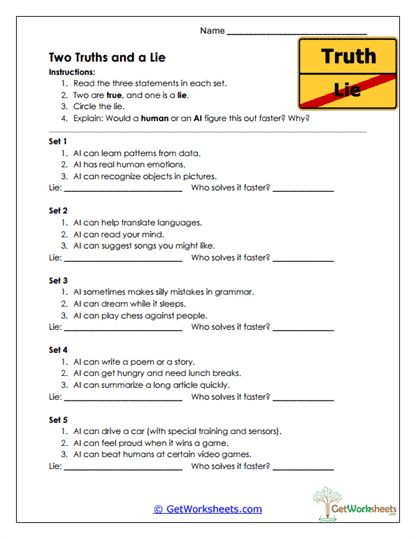
Two Truths and a Lie - AI Edition
Students read three statements about AI abilities and identify the false one. They then explain whether a human or an AI would detect the lie faster. The task reinforces understanding of AI strengths and limitations. It builds evaluative reasoning and clear written justification.
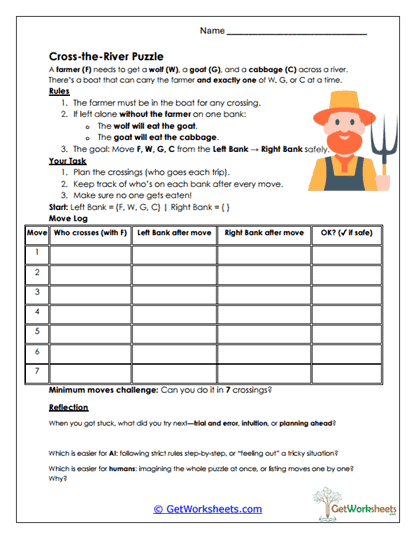
Cross-the-River Logic Puzzle
Students solve a classic problem involving transporting a wolf, goat, and cabbage safely across a river. They record each move, track states, and ensure no rule is violated. The worksheet supports step-by-step reasoning and strategic planning. Reflection questions help students compare human intuition to AI-style logical sequencing.
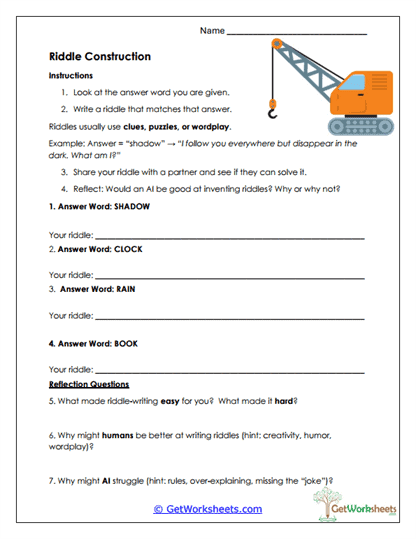
Riddle Construction
Learners create original riddles based on provided answer words, using clues and figurative language to craft solvable puzzles. They reflect on why humans tend to excel at riddle creation compared to AI. The activity strengthens creative writing and wordplay skills. It also promotes metacognitive thinking about human creativity and linguistic nuance.
Bookmark Us Now!
New, high-quality worksheets are added every week! Do not miss out!