Abolition of Man Worksheets
About This Worksheet Collection
The Abolition of Man Philosophy Study collection invites students to explore C.S. Lewis's profound reflections on morality, reason, and human purpose. These worksheets guide learners through the philosophical framework of The Abolition of Man, encouraging comprehension of Lewis's defense of objective value and critique of moral relativism. Students engage with concepts such as the Tao, natural law, and ethical education while connecting Lewis's arguments to contemporary moral and technological dilemmas.
This collection balances critical reading and reflective thought. Learners practice interpreting complex nonfiction, comparing philosophical viewpoints, and applying moral reasoning to modern challenges. Through discussion, essay writing, and conceptual mapping, students cultivate intellectual curiosity, logical reasoning, and moral awareness-skills that extend beyond the classroom into real-world ethical reflection.
Detailed Descriptions Of These Worksheets
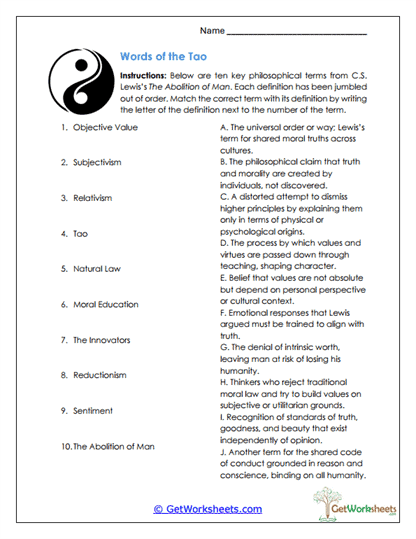
Words of the Tao
Students match key philosophical terms from The Abolition of Man to their correct definitions, deepening understanding of concepts like objective value and moral law. The exercise encourages precision in language and comprehension of abstract ideas. Learners strengthen vocabulary while exploring the philosophical foundation of Lewis's argument. By synthesizing related ideas, they gain a clearer view of how the Tao shapes moral reasoning.
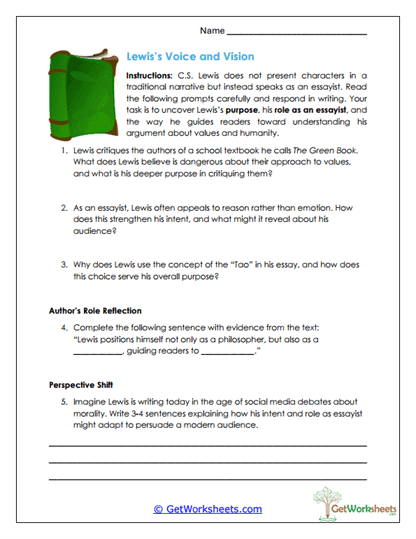
Lewis's Voice and Vision
This worksheet examines Lewis's rhetorical style and persuasive strategies. Students analyze tone, purpose, and argumentation, then reflect on how Lewis might express his message in a modern cultural context. Through guided short responses, they interpret how logic, emotion, and ethics interact in persuasive writing. The activity refines students' analytical reading and rhetorical awareness.
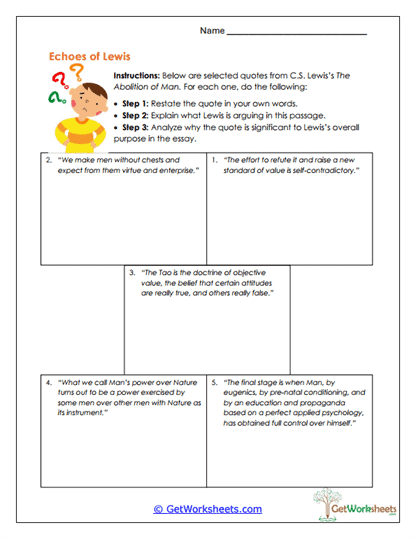
Echoes of Lewis
Learners unpack several of Lewis's most significant quotations, rewriting them in their own words and connecting each to a larger philosophical claim. They examine how Lewis's reflections on truth, education, and human nature reveal his defense of moral realism. This process promotes comprehension, textual interpretation, and evidence-based reasoning. It also encourages thoughtful engagement with philosophical expression.
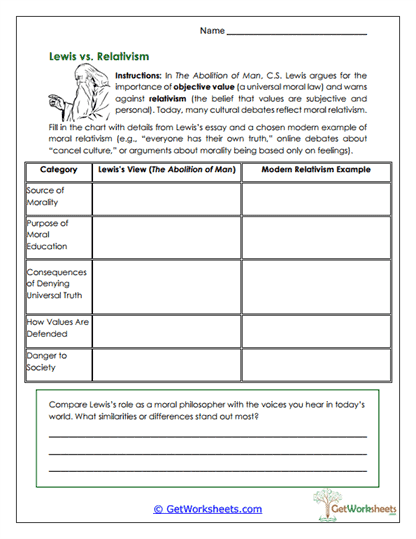
Lewis vs. Relativism
Students complete a comparative chart contrasting Lewis's belief in objective morality with modern relativist viewpoints. They explore differences in moral origins, education, and consequences for society. This task helps learners identify philosophical patterns and consider their effects on human behavior and governance. It supports synthesis of historical ideas with contemporary ethical debates.
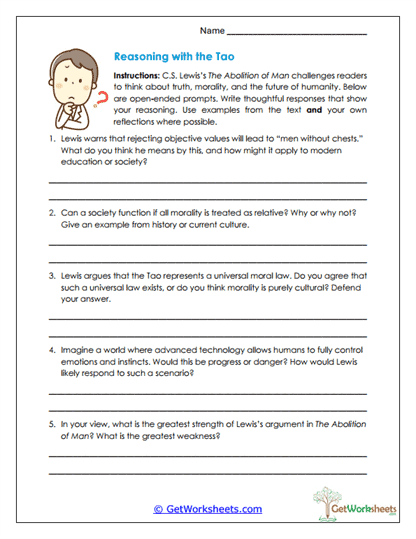
Reasoning with the Tao
In this reflective writing activity, students respond to prompts exploring how Lewis's ideas apply to modern education, ethics, and technology. Each response asks for examples and justification drawn from both text and experience. The exercise promotes analytical depth and moral reasoning while connecting philosophy to practical life. Learners practice constructing arguments that link abstract principles to real-world challenges.
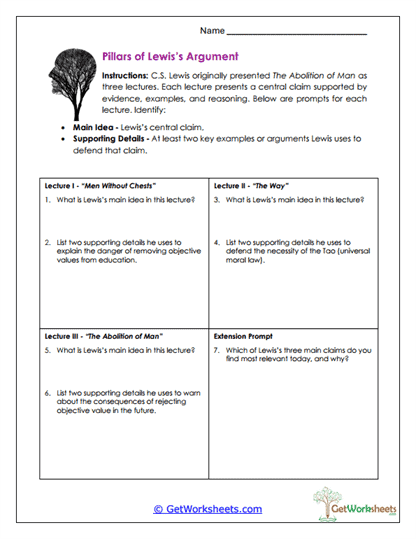
Pillars of Lewis's Argument
Students analyze the structure of Lewis's three lectures, summarizing each core claim and the reasoning behind it. The worksheet encourages logical organization and understanding of argument progression. By breaking down complex ideas, learners strengthen reading comprehension of philosophical texts. This close-structured task supports synthesis and thematic integration across the work.
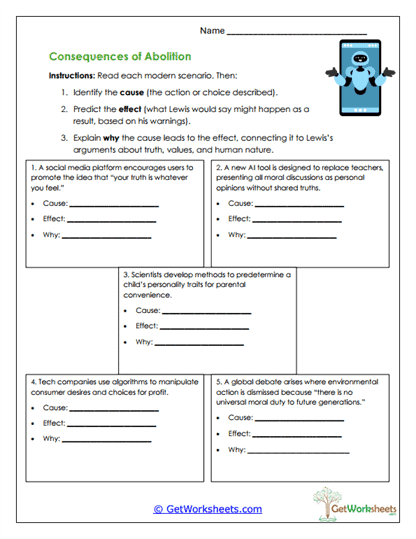
Consequences of Abolition
This worksheet uses a cause-and-effect framework to connect Lewis's ideas to modern ethical issues such as media influence, artificial intelligence, and moral education. Students identify causes, predict outcomes, and justify reasoning. The task promotes critical thinking about how moral decay or relativism might shape society. It encourages application of philosophical reasoning to real-world dilemmas.
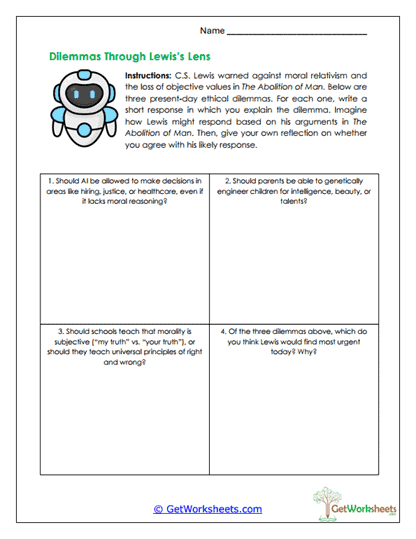
Dilemmas Through Lewis's Lens
Learners analyze modern ethical situations-like genetic engineering or algorithmic decision-making-through Lewis's philosophical perspective. For each case, they predict his likely stance and explain their own, developing comparative reasoning and moral reflection. This activity cultivates empathy, logical argumentation, and applied ethics. It encourages students to evaluate competing viewpoints thoughtfully.
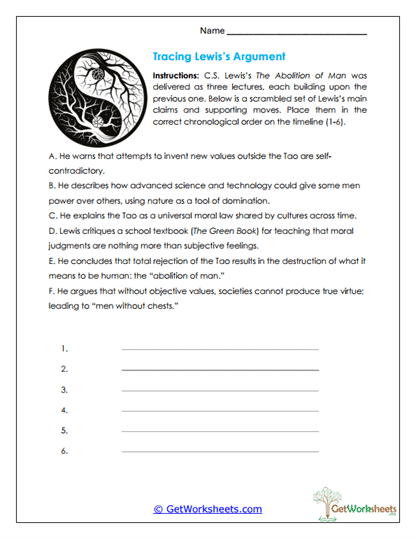
Tracing Lewis's Argument
Students organize key ideas chronologically to trace the logical progression of Lewis's central thesis. This sequencing activity reinforces comprehension of how argument builds across lectures and connects to overarching conclusions. It strengthens understanding of structure, flow, and interdependence in philosophical writing. Learners also practice identifying transitional reasoning and thematic coherence.
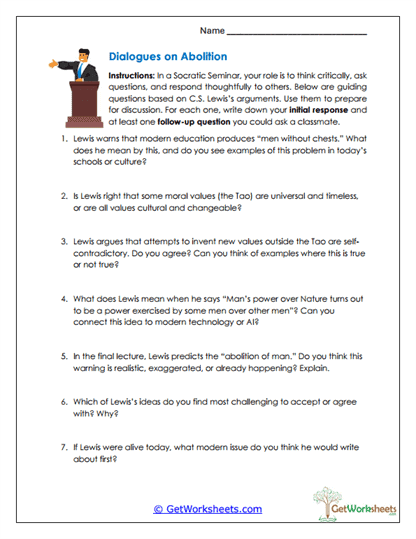
Dialogues on Abolition
This Socratic-style worksheet invites collaborative discussion on major questions from The Abolition of Man. Students prepare initial written responses, develop open-ended questions, and engage in group dialogue. The activity promotes respectful debate and higher-level inquiry. It deepens comprehension of Lewis's philosophy while enhancing communication and reasoning skills.
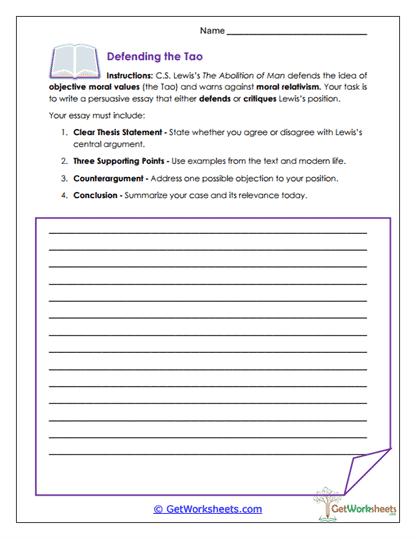
Defending the Tao
Students craft a persuasive essay either supporting or critiquing Lewis's defense of objective morality. They organize their arguments with a thesis, three supporting points, and a counterargument. The exercise teaches logical reasoning, evidence-based argumentation, and ethical clarity. It bridges classical philosophy and modern debate, encouraging precise and persuasive writing.
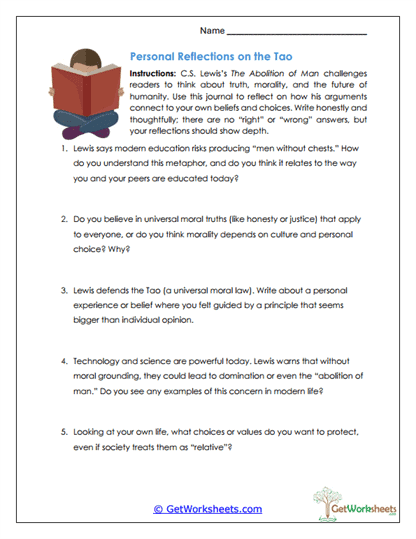
Personal Reflections on the Tao
In this reflective journal, learners respond to prompts connecting Lewis's ideas to their personal moral beliefs. They analyze universal ethics, cultural relativism, and the impact of technology on human values. The activity encourages introspection, philosophical self-awareness, and synthesis of abstract concepts with personal experience. Through reflective writing, students internalize Lewis's call for moral integrity and intellectual honesty.
Bookmark Us Now!
New, high-quality worksheets are added every week! Do not miss out!